Architecture: the two layers
These commands use physics-inspired names (nucleate, evolve, tackle, …). New to the vocabulary? See The physics vocabulary.
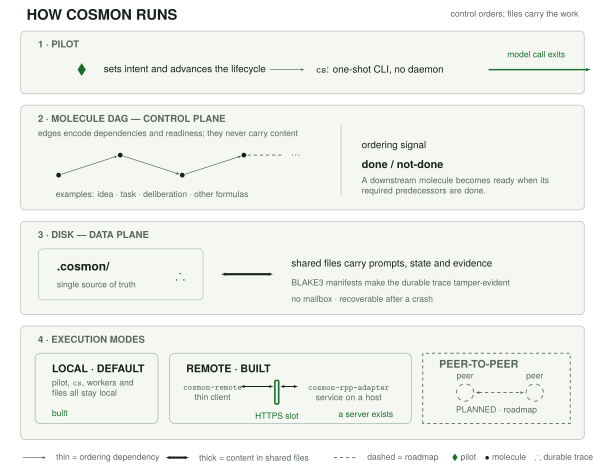
Cosmon is organized as two cooperating layers that share one state store. The first is everything you can touch today; the second is an optional process that sits on top without ever becoming load-bearing. Understanding this split explains most of cosmon's design choices at once.
Layer A: the Transactional Core (today)
The core is the stateless CLI. Every cs command is git-like: read state,
mutate, write, exit. No daemon, no lingering process. State lives on disk as JSON
files in .cosmon/state/, and that is the source of truth. Because each command
is a complete one-shot transaction, the core composes with any scheduler: cron,
launchd, a shell loop, a CI job, or a human at a terminal.
This is the load-bearing layer. Every capability cosmon offers is reachable here, human-driven, with nothing else running.
Layer B: the Resident Runtime (optional, additive)
The runtime is one long-lived process, cs run, with an event loop. It polls
the on-disk state, asks a pluggable policy what to do next (a DAG scheduler
today; a decay-aware re-planner or an external LLM-backed planner in the future),
and applies the answer through the very same commands the CLI exposes.
Four rules keep Layer B honest, and they are non-negotiable:
- It is a client, never a substrate. The runtime cannot mutate state through
any channel the CLI does not also expose. A human can
cs observeorcs freezea molecule while the runtime works on it; they are clients of the same file-based truth. - It owns no state. JSON on disk stays authoritative. Kill the runtime, restart it, and it rebuilds its entire picture from the files. There is no RAM it is afraid to lose.
- It is deletable in one move. Layer B is a separate build target; removing it never touches the core. Layer A does not require the runtime to exist.
- It is never the only path. Anything the runtime does, a human can do at the CLI. The runtime is pure convenience layered on a system that already works without it.
The three regimes formalize when each layer is in charge: Layer A drives the inert and propelled regimes; Layer B, when running, drives the autonomous regime, using Layer A's own doorways.
Inside the core: pure core, impure shell
The code mirrors the two-layer discipline at a smaller scale. cosmon-core
contains the domain (the state machines, the identity types, the validation)
and has zero I/O: no filesystem, no network, no async runtime. All the
messy outside world (reading files, spawning tmux, tracking tokens) lives behind
traits, implemented in separate crates.
graph TD
    CLI["cosmon-cli<br/>(the binary: clap)"]
    CORE["cosmon-core<br/>Pure domain logic<br/>State machines · types · validation<br/><b>ZERO I/O</b>"]
    CLI --> CORE
    CORE -->|trait: StateStore| SS["JSON files / SQLite"]
    CORE -->|trait: Transport| TR["tmux / process"]
    CORE -->|trait: EnergyTracker| ET["token accounting"]
This buys three things: the core is testable without mocks (it is pure functions over domain types), the backends are swappable (flat files today, SQLite tomorrow, without touching the core), and the transport layer can be hardened independently of the AI cognition it carries.
Two patterns worth knowing
Two Rust patterns do most of the structural work, and both trade a little verbosity for compile-time safety:
-
Typestate for the molecule lifecycle. Each lifecycle state (
Active,Frozen,Completed,Collapsed) is a distinct type, and transition methods exist only on the states that allow them. Trying toevolvea frozen molecule is not a runtime error checked with anif; it simply does not compile. The type system makes invalid transitions unrepresentable. -
Newtype IDs. Every identifier (
MoleculeId,WorkerId,AgentId) is its own wrapper type with validation on construction. It cannot be a bareString. Passing aWorkerIdwhere anAgentIdis expected is a compile error, and an ID that exists is guaranteed valid because it could not have been built otherwise.
The through-line of every one of these choices is the same physics framing: minimize the gap between what the system claims to do and what it actually does. Every invariant pushed into the type system is one fewer runtime surprise, and one fewer thing that can drift when an agent crashes.
For the design bet the whole architecture rests on, see Why a stateless CLI; for how it survives failure, see Crash recovery.