cosmon
Noogram is an open system for running long AI-agent missions inside your own perimeter, keeping every step as plain files you own. Its kernel, cosmon, is a stateless CLI that gives each agent an identity, a lifecycle, and crash recovery.
The code lives at github.com/noogram/cosmon,
open-core: the kernel, the CLI, and the runtime are AGPL-3.0-only, and the
network SDK third parties link to talk to an instance over the wire is
Apache-2.0 (LICENSE maps
the split crate by crate). It is early-stage but functional. The core types,
the cs CLI, state persistence, tmux transport, and the DAG engine all ship
today, and the API is still moving, so expect breaking changes before 1.0.
- A social organization of agents. A long mission becomes small tasks, each with a precise goal. Agents take them on side by side, wait on one another when one task depends on another, and cross-examine each other's findings through panels, reviews, and counter-arguments before anything reaches you. Work at scale, the way a good team organizes itself.
- Runs inside your perimeter. The agent works on your corpus, on your machine. Every step, every decision, and every result is written to plain files on a disk you control. Only the model call leaves your machine. There is no server in the loop, database, or Cosmon account.
- You stay the judge. The agent hands you a draft on its own branch, with its reasoning and evidence alongside; what the gates couldn't verify is marked unverified, never silently accepted. Nothing lands until it passes your gates.
- The story can't be quietly rewritten. Every mission leaves a complete,
replayable work record. If anyone, human or agent, edits it after the fact
without resealing it,
cs verifynotices. It detects accidental edits; a determined forger can rewrite the record and its seal. - Work survives a crash. Everything the agents record lives in those same plain files, so a fresh worker picks up where a crashed one stopped.
- A harness over the harnesses you already use: Claude Code, Codex, Aider, and other CLI agents; hosted APIs from Anthropic, OpenAI, Google Gemini, Mistral AI, Qwen, DeepSeek, GLM, Kimi, and more; or local models through llama.cpp and Ollama.
- Federate (under construction). Several machines cooperating on one mission, with no central owner.
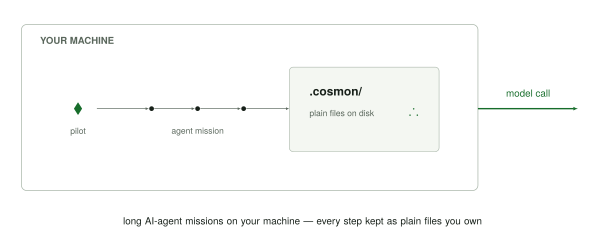
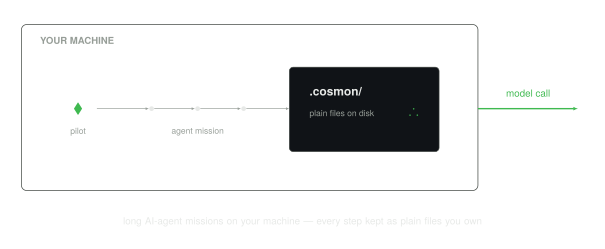
noogram and its cosmon kernel
On a single machine, the tool you run is cosmon; its command is cs. You
cs tackle a piece of work to start an agent on it, and cs done to close it
out; the record of both lands under .cosmon/.
Noogram's ambition is a federated agentic system: many cosmon instances
cooperating, each keeping its own record, with no single owner in the middle.
The first brick is already here: the remote mode, where a cosmon-remote
client talks to a cosmon-rpp-adapter service over HTTP(S) on another host.
Broader peer-to-peer federation between instances is on the roadmap; the shape of
that link is still being explored. That larger, cooperating whole is noogram;
cosmon is its kernel. Today, run several agents in parallel on one machine and
cosmon does that by itself, complete and standalone. See
Noogram & the Cosmon kernel for the
relationship, and Agent adapters for how a concrete
agent or model plugs in.
Where to go next
- Want it running now? Install cosmon, then Ten minutes to cosmon takes you from an empty terminal to one merged piece of agent work.
- New here? The Explanation section is the conceptual on-ramp: the physics vocabulary, the kernel/distribution split, formulas and adapters and fleets, and how cosmon survives crashes. Start there.
- Learning by doing? The tutorials walk you from your first molecule to your first fleet to composing a DAG.
- Looking up a command? The CLI reference is
generated from the tool itself, grouped by role. The full
nucleate → tackle → wait → donecycle is covered in The three regimes.
This site is built by mdBook and rendered by the same pipeline that builds cosmon's own documentation.